Sons And Lovers
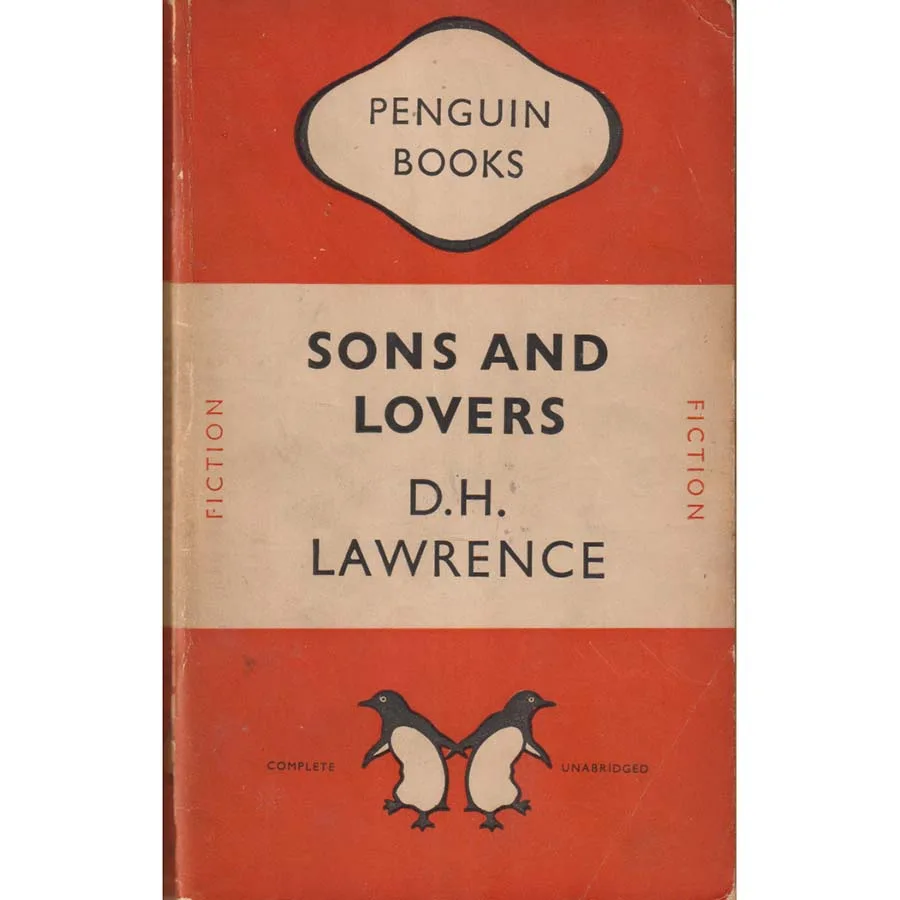
Publisher: Penguin
Format: Paperback
ISBN: none
Families are complicated arrangements. Parents have expectations, children develop inconvenient personalities, marriages become battlegrounds and everybody eventually discovers that the people they love most are often the people best equipped to make them thoroughly miserable. D. H. Lawrence, never a writer to overlook a promising emotional catastrophe, turned these domestic difficulties into one of the most powerful novels of the twentieth century.
Has a concave spine.
Sons and Lovers (1949), by D. H. Lawrence and published by Penguin, is an extraordinary exploration of family relationships, class, ambition, sexuality and the uncomfortable consequences of a mother becoming rather too involved in her son’s emotional development.
Originally published in 1913, the novel draws heavily upon Lawrence’s own upbringing in the Nottinghamshire mining communities, where industrial hardship, social aspiration and domestic tension provided enough material for several lifetimes of psychological investigation.
At the centre of the story is Paul Morel, a sensitive and artistically inclined young man growing up in a working-class family dominated by the increasingly bitter relationship between his parents. His father, Walter, is a miner whose earthy vitality and working-class habits clash with the aspirations of his more refined wife, Gertrude.
Disappointed by her marriage, Mrs Morel invests enormous emotional energy in her sons, particularly Paul, creating a bond of extraordinary intensity. Unfortunately, this arrangement becomes rather problematic when Paul begins developing romantic relationships of his own.
His involvement with the spiritual and intellectually demanding Miriam Leivers, followed by his passionate relationship with the more worldly Clara Dawes, reveals a young man spectacularly incapable of reconciling romantic desire with his attachment to his mother.
The resulting emotional complications are enough to make a modern family therapist consider abandoning the profession altogether.
Lawrence examines these relationships with remarkable psychological insight, exposing the hidden resentments, dependencies and contradictions that influence human behaviour. His characters are neither straightforward heroes nor convenient villains, but complicated individuals struggling to understand themselves while frequently causing considerable distress to everybody else.
The novel also provides a vivid portrait of industrial England, capturing the mining communities, domestic routines and social divisions that shaped Lawrence’s early life. His descriptions of the natural world offer moments of extraordinary beauty amid the emotional turbulence, suggesting that flowers and landscapes occasionally possess a greater capacity for peace than human beings.
There is something wonderfully ironic about the novel’s central predicament. Paul desperately seeks independence, artistic fulfilment and romantic happiness, yet remains emotionally entangled in precisely the relationship from which he most needs to escape.
Condition: Fair. This 1949 Penguin edition is a vintage paperback showing noticeable signs of age, reading and handling. It has survived more than seven decades of literary enthusiasm and domestic upheaval, although its physical condition now reflects that considerable experience. A reading copy rather than a pristine collector’s specimen.
Offered by Crappy Old Books, where we appreciate complicated families, great literature and the reassuring knowledge that most domestic disagreements do not eventually become internationally celebrated novels.
No ISBN, naturally. In 1949, books were still expected to identify themselves through their titles, authors and the occasional scandal.
A powerful, beautifully written and psychologically penetrating classic for admirers of Lawrence, lovers of English literature and anyone who has ever suspected that family relationships might be considerably easier if everybody occasionally left one another alone.
Keep browsing: See more Modern Classics books Other books by DH Lawrence